Highly Superior Autobiographical Memory (HSAM) also known as Hyperthymesia: What is it, who has it and where does it come from?
“It’s kind of like time travel. That’s the way I usually describe it,”
— Louise Owen, HSAM Patient
Authors: Eileen Clinton and Bailey Hall
Highly Superior Autobiographical Memory
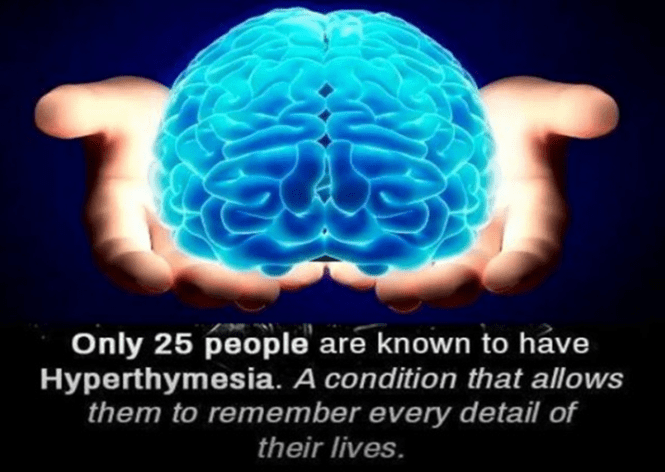
Which day of the week was September 3rd, 2007? What did you eat for breakfast two weeks ago? If you’re like most people, your memory is not detailed enough for you to recall such everyday minutiae. But for fewer than 100 people across the world who share a syndrome called hyperthymesia, or highly superior autobiographical memory (HSAM), remembering specific details of particular events long after they occur is a natural function of life. In general, individuals with HSAM have accurate, precise memory of personal and news events for almost any given day from approximately age 5 and onward (Patihis, 2016).
History
While it is possible that some individuals have possessed this ability for centuries, Parker, Cahill & McGaugh documented the first case in 2006. They reported on a woman referred to as A.J. who, unlike most other individuals with superior memory, did not possess a remarkable ability to encode and repeat back long spans of digits, but to her own exhaustion would compulsorily recall the day of the week and personal events that occurred for any given date beyond age eleven (Parker, Cahill, McGaugh, 2006). In this case study, the researchers learned that A.J.’s memory was truly automatic rather than strategic, as she faced difficulty in harnessing her abilities to learn and remember new information. Parker et. al administered a battery of standardized tests to A.J. assessing a wide variety of cognitive and intellectual abilities.
Unsurprisingly, they found that A.J. scored perfectly on an Autobiographical Memory test, which prompts specific personal memories; A.J.’s 24 years worth of diaries were used to verify the accuracy of her recollections. Other notable results revealed that presenting specific dates automatically cues her recall, though her impeccable memory is limited to years within her personal mental calendar, days that she lived through after early childhood. Once one memory was prompted, A.J.’s brain inescapably recovered a related one, a more severe version of the phenomenon referred to as memory chaining (Mace, 2007). Interestingly, A.J. exhibited poor facial recognition and executive functioning in the form of reflection, abstraction, and inhibition; the researchers speculate that her HSAM may cause these executive difficulties by preventing the ability to “switch her memory off.”
Possible Explanations
Memory researchers have produced a few possible hypotheses for why some individuals have HSAM.
Sleep consolidation
Previous psychological research has established that sleep is vital for consolidating procedural and episodic memory, or motor skill memory and memory of autobiographical events (Stickgold, 2005). The sleep consolidation theory of HSAM proposes that these individuals with superior memory experience greater sleep quality, which results in greater autobiographical memory consolidation (Patihis, 2016). So, people with HSAM are so good at remembering things because they sleep better than the rest of us!
Emotional arousal
James McGaugh, one of the researchers who worked with A.J., proposed another hypothesis for hyperthymesia: emotional arousal. Various studies have reported findings that emotional arousal enhances memory retention (Anderson et. al, 2006; Liu, Graham, & Zorawski, 2008). McGaugh suggests that the brain systems of HSAM patients that modulate emotional arousal may be more sensitive to somewhat arousing experiences, or are more highly activated (McGaugh, 2013). In this sense, someone with HSAM may generally register their experiences as more stimulating than someone with a regular memory would, so those experiences are more firmly encoded in memory.
OCD
Remember the compulsive way in which A.J.’s memory would recall past experiences?
Some memory researchers have proposed that individuals with HSAM are presenting with Obsessive-Compulsive Disorder, or OCD. Persons with OCD have uncontrollable, recurring, and sometimes disturbing thoughts, and/or behaviors that they feel urged to repeatedly perform (NIMH, 2019). Leport et. al performed a study in which they found indistinguishable differences between the symptom scores of individuals with OCD and individuals with HSAM, suggesting that people with highly superior memory are experiencing a kind of obsessive memory that leads them to have much greater retention than the rest of the population (2016).
Certain areas of the brain that are different in those with OCD also seem to be different in those with HSAM (LePort et al., 2012). The fact that these brain areas look similar in those with OCD and HSAM is more evidence for the link between these two conditions.
Other similar conditions
Superior Autobiographical memory is one of several conditions that causes one’s memory to be special. While those with HSAM can remember nearly every day of their lives, they are no better than average at memorizing digits of pi or packs of playing cards. People with these abilities are called mnemonists (Morrison et al). If you wish you had such abilities, you may be in luck. Author and journalist Joshua Foer initially heard of this condition by covering a memory tournament for his job but soon decided to pick up the hobby of memorization himself. He now competes at these tournaments. Foer believes that anyone can become a mnemonist through training.
Similarly, those with HSAM are not savants. Savants are autistic individuals with superior memory abilities. These abilities vary in nature, but they are abilities that savants are born with, not ones they develop over time. Examples of savant abilities include the ability to calculate what day of the week a calendar date will be, the ability to memorize thousands of pieces of music or to be able to draw an entire cityscape from memory.
Pros and Cons
Do you wish you had highly superior autobiographical memory? Being able to recite what happened on what date would certainly make for a cool party trick. Brad Williams, a radio news anchor from Wisconsin, says his memory comes in handy at work. However, there also appear to be downsides to possessing HSAM. People may find you weird or creepy if you remember them after one meeting several years ago or if you remember personal details about them that they don’t remember about you. It can be isolating to have an ability that virtually no one else has. In the same way that it may be frustrating for a neurotypical person to talk to someone with Alzheimer’s, to someone with HSAM, people with normal memories seem incredibly forgetful.
Louise Owen, a freelance violinist living in New York and one of the twelve people currently confirmed to have HSAM, reports that when she thinks back to past emotional memories, she feels the emotions as if they happened yesterday. Owen was asked about the time she found out her parents were moving at age 13, and she explained, “it’s like all of a sudden I feel like this really heartbroken little 13-year-old all over again.” (CBS, 2011).
Despite the negative aspects of this condition, many of those with it are glad they have it. Both Louise Owen and Brad Williams said they are glad to possess HSAM. Owen mentioned that it helps her live each day with more intention, since she knows she will remember it forever and therefore wants to make it count.
______________________________________________________________
Sources:
Anderson, A.K., Yamaguchi, Y., & Wotjek, G. (2006). Emotional memories are not all created equal: Evidence for selective memory enhancement. Learning & Memory, 13, 711-718. doi: 10.1101/lm.388906
“British Psychological Society.” British Psychological Society, vol. 26, no. 10, Oct. 2013, http://www.thepsychologist.org.uk. Accessed 20 Nov. 2019.
Cbs. NYC Resident Louise Owen Never Forgets A Thing — Literally. 20 Sept. 2011, https://newyork.cbslocal.com/2011/09/20/nyc-woman-with-a-unique-ability-she-literally-never-forgets-a-thing/.
Leport, A.K., et al. Behavioral and Neuroanatomical Investigation of Highly Superior Autobiographical Memory (HSAM). Neurobiology of Learning and Memory, vol. 98, no. 1, 2012, pp. 78–92., doi:10.1016/j.nlm.2012.05.002.
LePort, A. K., Stark, S. M., McGaugh, J. L., & Stark, C. E. (2016). Highly superior autobiographical memory: Quality and quantity of retention over time. Frontiers in psychology, 6, 2017. doi:10.3389/fpsyg.2015.02017
Liu, D.L. Graham, S., & Zorawski, M. (2008). Enhanced selective memory consolidation following post-learning pleasant and aversive arousal. Neurobiology of Learning and Memory, 89(1), 36-46. doi: 10.1016/j.nlm.2007.09.001
Mace, J.H. (2007). Involuntary memory [E-Reader Version]. Retrieved from https://onlinelibrary.wiley.com/doi/pdf/10.1002/9780470774069
McGaugh, J.L. (2013). Making lasting memories: Remembering the significant. Proceedings of the National Academy of Sciences110(Supplement 2), 10402-10407. doi: 10.1073/pnas.1301209110
National Institute of Mental Health. (2019). Obsessive-compulsive disorder. Retrieved from https://www.nimh.nih.gov/health/topics/obsessive-compulsive-disorder-ocd/index.shtml
Parker, E. S., Cahill, L., & Mcgaugh, J. L. (2006). A case of unusual autobiographical remembering. Neurocase, 12(1), 35-49. doi: 10.1080/13554790500473680
Patihis, L. (2016). Individual differences and correlates of highly superior autobiographical memory. Memory, 24(7), 961-978. doi: 10.1080/09658211.2015.1061011
Stickgold, R. (2005). Sleep-dependent memory consolidation. Nature, 437, 1272-1278. doi:10.1038/nature04286
The Gift of Endless Memory. https://www.cbsnews.com/news/the-gift-of-endless-memory/.
 Autobiographical Memory